|
|

|
Chemistry
The number of people who have no intention to work or who are not working is increasing. As indicated by the kanji character which means "to work", it means to continue our life by moving and sweating; it is different from just having a "job". Having an income is not equivalent to work. It is fortunate if we can work and the happiness which comes from our being able to work is real happiness. So many retired old men who look boring and women who just try many free food samples without buying anything at the food floor of department stores are living at the housing complex I live in. They seem to be products of our pensions. The systems related to pensions, nursing care and subsidies created by stupid elites have ruined us and destroyed the history and culture in towns and cities in Japan. Children are seemingly beautiful potted plants by being grown up to their parents' satisfaction. Can we call such a situation happy?
Two years ago, at a corner of my town whose streets and buildings have significantly been remodeled, an old-fashioned Japanese sweet shop run by students was opened. There are so many children who are smiling proudly like an adult in the shop. No smartphones! This is what we should be!
Originally, Japanese culture was born in a small tatami-mat room. It is not the culture cultivated in an open space but in a small room or alley. Speculations, politics, ideas and words of love have been born from the conversations in a small tatami-mat room. It is based on a Japanese-specific chemistry with a distinct interval and depth grown with the Japanese language which is the most delicate and poetic language in the world. Originally, Japanese language with sensitive words was not appropriate for speeches, discussions and laws. Actually, democracy which has directly been imported from the western world and values largeness, broadness and abundance cannot be implemented in Japan. "Bigness is better" cannot always be applicable to events, theaters or amusement parks.
Incidentally, the owner of Gallery Ryo suddenly passed away last autumn and the gallery was closed. So, my one-man exhibitions which have been held for 10 years during the Sakura Festival at the end of April have been canceled. I feel lonely rather than sorry by the news, but due to the heartfelt effort by people in Hirosaki including Mr. Yasushi Nakamura, my one-man exhibition will be organized for 3 days from May 17 to 19 at Tanakaya Gallery at Ichiban-cho. I am looking forward to your visiting the exhibition.
On April 5, in Tokyo with cherry trees with fresh green leaves Tsuzen Nakajima
|
Unsurpassed
 Mail order is prevalent. TV and newspapers as well as the Internet are blatting to say that they are cheap, convenient, easy, safe and that they can save you money. We do not have to go all the way to real shops; we can get what we want just by making a phone call. Japan has been referred to as a great manufacturer for a while, but where does the economy of consumption lead us by diluting the street, society and human relationships? It is much scarier than TPP! Mail order is prevalent. TV and newspapers as well as the Internet are blatting to say that they are cheap, convenient, easy, safe and that they can save you money. We do not have to go all the way to real shops; we can get what we want just by making a phone call. Japan has been referred to as a great manufacturer for a while, but where does the economy of consumption lead us by diluting the street, society and human relationships? It is much scarier than TPP!
In December 2012, a Japanese lady who has a French husband happened to come to my exhibition at the Carrousel du Louvre. She mentioned that she found a nice work among several block prints given by her husband to her as her birthday presents the other day. She wondered who the artist was, but was so surprised to know that it was me who exhibited works there.
The small work has never been exhibited nor sold in France, so I asked her how he got it. She mentioned that he got it via an auction. I wondered how my work came all the way to France crossing the ocean. As an artist, I felt happy but sad at the same time knowing the process. I told a friend of mine who is a dentist about this story. Then he said "You are lucky because your works remain. No matter how good a job as a dentist I did, my work will be burnt to ashes at a crematory and is all over!"
Certainly. But we have one thing that surpasses anything, money or name and should be left to the next generation! Needless to say, it is children who have long been cherished as a "treasure which is much more superior to silver or gold" since the Manyo period as in a poem by Yamanoueno Okura.
There is a nursery next to the housing complex I live in. Children's voices echo throughout as early as in the morning. Old people who are taking life easy on their pensions are disrespectfully complaining that they are noisy, but how the hell can they say such a thing! Their voices are purer than any singers' voices. They are selfless and a pure echo of life's energy! This energy can never be delivered by mail order. Our national recovery should start from here.
Incidentally, my new collection of works released last autumn has surprisingly been well received. The entire city of Saint-Maur welcomed me and I was given a Gold Medal at the exhibition organized in Saint-Maur. I am truly grateful to Ms. Brigitte Perol and people from Saint-Maur City and Paris who supported me.
January 1, 2013 at the start of the New Year - Tsuzen Nakajima
|
"Loss of "public" consciousness"
When Governor Ishihara announced that the Tokyo Metropolitan Government intended to purchase the Senkaku Islands, I felt that I "witnessed" what "politics" are after a long interval. His remark moved society which has long been in a stuck situation and aroused our "public" consciousness instead of our "private" consciousness. It was a good chance for the Japanese to finally become an independent adult after the war. However, the Japanese Government suddenly purchased the island for its own advantage and defensiveness which led to a disappointing and irritating result for many of the nation with an absolute honesty.
Its impact was heavier than the violence, threatening action and boycott by the Chinese because an occasion which was better than last year's disaster for our recovering "public" consciousness was completely damaged. The Noda government is especially responsible for having caused this situation! Now our interest in the "public" disappears and a sense of stagnation and helplessness is becoming stronger and stronger. Delitescence and lack of responsibility are nurtured which makes our society as if we do not have any government which gives us uncertainty for the future.
Early October 2012 - Finally, autumn comes - Tsuzen Nakajima
|
 |
"Self-centeredness"
 On the train in the late afternoon, almost all the passengers are playing with their mobile phones. People like me who do not have one are treated almost as peculiar characters rather than as a minority. A decade ago, we used to read books or pretend to fall asleep on the train, but now we seem to use mobile phones instead. On the train, they must exchange electromagnetic rays as in a microwave oven. People who are playing with mobile phones do not care about others at all. I feel rather "scared" by looking at such a weird scene. On the train in the late afternoon, almost all the passengers are playing with their mobile phones. People like me who do not have one are treated almost as peculiar characters rather than as a minority. A decade ago, we used to read books or pretend to fall asleep on the train, but now we seem to use mobile phones instead. On the train, they must exchange electromagnetic rays as in a microwave oven. People who are playing with mobile phones do not care about others at all. I feel rather "scared" by looking at such a weird scene.
All the time, both a positive side and a negative side lie in everything we do. Mobile phone providers just emphasize its novel convenience but do not talk about its concurrent adverse effects. Probably, they have a significant amount of information and data about such adverse effects, but the media does not take it seriously. Such neglect is the scariest thing to me.
The number of people who do not step out of others' way when we almost bump into others on the street has increased. Whether they are playing with their mobile phones or not, they tend not to give their way. They do not say anything if I give my way; they walk past as if they do not even see me. As if they have a narrowed visual field. I not only feel frustrated but scared. It does not seem like a problem about the range of vision; I cannot help but say that their circuits for reacting or thinking in their brains seem to have become narrower. Such people may jump into the rows of passengers if they drive a car.
We'd better think that it is a spread of the new egoism which can be referred to as "self-centeredness" more as the increase of persons with meism. They are different from traditional, aggressive egoists who try to advance their own interests; prevailing modern self-centered persons have strong defender instincts and disregard others based on self-protection.
The Japanese love "Japan" but not the Japanese! We are genial to peers, customers or celebrities, but confoundedly cool and sour to strangers. We will have no future and no solutions about depression, increases in taxes and the falling birthrate without solving this big issue.
This year, I have already organized 6 exhibitions in Japan and France and my health is almost at the limit, but I am in the process of creating my new collection book. Please look forward to it!
On June 30, 2012, at a sunny interval during the rainy season Tsuzen Nakajima
|
|
Strength
There is nothing so marvelous and impressive like the facial expressions of their Majesties the Emperor and Empress who attended the Tohoku memorial service on March 11 to mark the first anniversary of the Tohoku Earthquake. Their postures and facial expressions while they were walking on a podium were so awesome and sublime, unlike anything that has appeared on any Noh performers or Noh masks. I felt as if I was watching a scene of an "authentic" Noh play. They are an anchorage of us, the Japanese. The strength they have is true "nothingness" of mind which creates a strong impression in us like deep belief. Desire, beauty and words in our minds are so powerless in front of the power of their true "nothingness".
No politicians or indolent people of the media have such a power. You can just play around forever!
We easily forget about the tomfooleries we have done. No reflection. Our minds will soon focus on new things and forget about and throw away old things. Then, we will repeat the same cycle. In the end, the Japanese will result either in resignation or in satori.
Incidentally, I was not able to spare much time for creative work due to preparation for an exhibition at Carrousel du Louvre last year; the only major work I created was a reproduction of an old school building of Kumagaya High School in Saitama Prefecture which is called "Aka-iraka (red roof tile)" in my woodprint. It was a request from alumni including my friend, Dr. Ko Sasaki. It took me almost a half year to complete. They liked my work very much and donated it to their old school for current students. They allowed me to exhibit the work for my one-man exhibition in February. I am truly grateful to all the alumni who came to see it.
This year, I am planning to publish a new collection of works including big pieces, recent works and those which were exhibited at Carrousel du Louvre. I am trying to manage to publish calendars this year. I would appreciate your kind support.
Tsuzen Nakajima on my birthday, March 30, 2012, with flowering of cherry blossoms
|
After returning from the Louvre
The big problem which is left after the Tohoku Earthquake is that we cannot believe in anything easily. The only thing we can believe in is the smiles of infants. We have to be doubtful about everything which is said, written and displayed by mass media, politicians, public servants, industry, commercials and research into the period for dramas, even about people's smiling faces. From a different viewpoint, it may be good because we became more careful about judging everything by ourselves; however, it is hard to restore confidence in anything once we felt that we cannot believe it. All the Japanese, be honest and do not keep on telling lies and hiding facts! Those who have been telling lies and hiding facts may not be open-eared, but we have to realize that honesty is the best solution when we are in trouble.
Once, the Japanese were said to be clean and courageous. Kafu Nagai, a famous Japanese novelist, said that "Do we need to exist if we have to be ignoble and monstrous to survive?" We are being out of others' minds when we are still alive.
From December 8 to 11, I participated in an exhibition by the Société Nationale des Beaux Arts in a huge floor of Carrousel du Louvre in Paris. I was allowed to display my 12 works on a wall over 12 meters. I am truly grateful to the visitors who came all the way from Japan, people in Paris, related persons at the Carrousel du Louvre and others in France. There is a young Japanese lady living in Paris who was looking at my works with tears in her eyes; I am glad that visitors such as her felt "Japan" even just a little while, and I was awarded a prize which was a surprising joy.
I heard that my works will be displayed at the Maison de la culture du Japan à Paris in January and Fontainbleau in May. I would like to express my sincere gratitude again to Ms. Shiori and her husband François.
On the Emperor's Birthday Tsuzen Nakajima
|
 |
Let's save on TV, get rid of TV
 We felt so gratified with the resignation of the former Prime Minister who was stuck to his position like black fungus in a bathroom. However, mass media, politicians, public servants and intellectuals covered with boiling scales are still humming in a comfortable warm bath. We felt so gratified with the resignation of the former Prime Minister who was stuck to his position like black fungus in a bathroom. However, mass media, politicians, public servants and intellectuals covered with boiling scales are still humming in a comfortable warm bath.
We, the Japanese, tend to be strict on tiny mistakes, but easy on injustice, unlawfulness and negligence. What happened with our pursuit of politicians' contributions of money? Average persons have been trying to keep the fire by diligently placing logs with sweat, but we do not know until when we can keep the fire burning with our effort.
Foolish and crazy programs and commercials on TV after the fever about the transfer to the terrestrial digital broadcasting are not just uninteresting but disgusting. The people who appear on TV programs are too cowardly to face the truth and wear a smile on their faces like a mask. I see no good faces on TV! It seems that the people who produce new programs and commercials believe that they can get a good image and viewer rating only if they show disaster victims and children. Why don't they save on TV or get rid of TV if they actually recognize the importance of saving energy?
The only thing I feel relieved and saved is the facial expressions and words of the Emperor and Empress who visited disaster sites. Unknowingly, they made my eyes fill with warm tears which I almost forgot about.
Incidentally, about 10 of my works will be displayed on a wall over 12 meters in the Louvre Museum in France from December 8 to 11. I will be taken up as a "noteworthy artist" in the salon organized by the Societe Nationale des Beaux-Arts with a tradition of 150 years under the sponsorship of President Sarkozy. It is so honorable and I would like to express my sincere gratitude again to the government and nation of France and all the related persons. Especially, I feel special gratitude to Ms. Shiori Saito and her husband Francois in Paris who have been helping my one-man exhibitions since three years ago and who kept on providing us strong support in various ways. I am also truly grateful to Mr. Kojiro Akagi, an artist in Paris, for his support. Here again, I would like to express my deepest gratitude to all the people in Japan and in other countries who warmheartedly support my creation of works and purchased my works.
On September 6, 2011 after passing o f a typhoon - Tsuzen Nakajima
|
Think
you're so smart?
The Tohoku Earthquake on March 11 which falls on the anniversary
of the death of Emperor Jinmu shone the light of the day on
the one-eyed inability of white collars including politicians,
bureaucrats, media and intellectuals. The prime minister and
his followers who intimidated and boosted political leadership
were just like parasites on the country and the national Diet.
Under the democracy after the war, we reconciled ourselves
to choose such parasites by being influenced by the media.
What the hell is politics? Now the democracy has reached its
criticality and our no-need feelings toward an election system
and politicians just keep on increasing. Only the sufferers
can put their bitter experience to use. They never realize
the pain of workers who produce things with sweat by risking
their necks for a slight amount of profit!
We forget our repentant attitude the minute the danger has
passed. Underestimating others and overestimating ourselves
is foolish for us. Disasters destroyed dinosaurs, but not
countries. Countries have always been and can only be destroyed
by human disasters!
Major media which just believes in opinion polls with no religious
devotion and is not afraid of Shinto and Buddhist deities
has become so insolently depraved. Before offering contribution
money or relief money, why don't they make a small amount
of money by offering to shrines and temples and pray?
My one-man exhibition in Hirosaki which was not impacted in
a major way by the disaster was only for three days, but the
cherry blossoms in the Hirosaki Park were unusually transparent
and beautiful. Immediately after the exhibition, I had another
5-day exhibition in Ohwani. We had more than 1000 visitors
per day and I am truly grateful to all of them.
Incidentally, suddenly I had a contact from Paris in January
and about 10 of my works will be displayed on a wall over
12 meters in the Louvre Museum in December. I will give you
more details later.
On May 8, Mother's
Day Tsuzen Nakajima
|
|
What
the hell is this?
 Even
after the New Year, the ignorant and incapable play with politics.
They are entirely-focused on performance and grandstanding,
and TV hides dirty linen and only repeatedly shows worthless
information. The current business depression must not relate
to lack of money but our pressed feeling for survival due
to information overload! Why don't you, the well-paid politicians
and financiers, read "Joganseiyo", a Chinese classical
emperor learning before getting down on your knees to China!
I am so ashamed of our having a Prime Minister who cannot
even read kanji. The only way we can survive is that all of
us become self-employed workers. Even
after the New Year, the ignorant and incapable play with politics.
They are entirely-focused on performance and grandstanding,
and TV hides dirty linen and only repeatedly shows worthless
information. The current business depression must not relate
to lack of money but our pressed feeling for survival due
to information overload! Why don't you, the well-paid politicians
and financiers, read "Joganseiyo", a Chinese classical
emperor learning before getting down on your knees to China!
I am so ashamed of our having a Prime Minister who cannot
even read kanji. The only way we can survive is that all of
us become self-employed workers.
Last year, the Japanese chemist who received the Nobel Prize
suddenly started to emphasize that competition is important,
but it is only required for sport; no competition is required
for learning, literature and art! Competition must lead to
destruction of tradition because it only pursue popularity
and novelty. Tradition is the continuation of attractiveness
and trust. It is transferred from parents to children, masters
to pupils, seniors to juniors via experience. It is summarized
into a phrase, "I count on you!"
The other day, my daughter and her husband went to the Taro
Okamoto Museum of Art with their 3-year-old son. Adults around
him were seriously looking at a piece of art, but after he
suddenly yelled, "what the hell is this?", all of
these adults broke up at once as if they noticed something.
As in the case about elections, it must have been an honest
yell of warning for adults who are brain-washed by the media
and prejudiced for so long. We cannot downgrade children.
Even after the New Year, people still say that we need dreams
like the Novel Prize winner. Dream is a rare word which has
been so emptily perplexing us. For children, everything is
real. Children are realists and we cannot downgrade their
sensitivity. "What the hell is this?" - that's it!
Information overload increases our anxiety and stress. Its
destination is boredom! Boredom covers the earth wider than
a warm temperature trend and cold waves. Nothing is more terrible
than boredom. We do not know what will happen by boredom.
Proliferation of boredom which leads to the hell of boredom!
China which is vigorously pushing forward to rise up and its
selfishness must be the best target for boredom. We cannot
make a fool of the wisdom of history, tradition and recurrence.
Bringing in the New Year, it is my 50th year after starting
wood block prints. Independent-study seems to be cool, I just
hate to be instructed on anything by anyone. This hate made
me encounter a pickpocket during the exhibition in Paris last
year because I too relied on a map and my hunch, and also
made all my books of collections stolen at the gallery. I
received offers from France and the Netherlands this year,
but I cannot yet make up my mind because it requires of me
a lot of strength and funds. I have a one-man exhibition at
Seigetsudo Gallery in Ginza in February. My work of cherry
trees will finally be completed after 15 years. I have one-man
exhibitions in Hirosaki which celebrates the 400 years after
Hirosaki Castle was built and is famous for cherry blossom
and Ohwani at the end of April. Please cheer for me.
On the New Year
day in 2011 with fair weather Tsuzen Nakajima |
"Chideji
(terrestrial digital broadcasting)" fever
 Our degradation seems to be so serious.
I am not just talking about politicians and TV personalities
full of claptraps. All the housewives, big buddies, teachers,
youngsters, scholars, officers, law judges and everyone. Everyday
before cicadas come out of the earth, TV loudly yells "chideji,
chideji". Female announcers of NHK urge us to shift to
"chideji" telling that it is "convenient and
easy" in a "go-go" mood like we had during
World War II. Is convenient and easy so good? I bet that nature,
lives, men, women, children and seniors are having a good
time and fun because we are living in troublesome and awful
times which requires our full effort.
Our degradation seems to be so serious.
I am not just talking about politicians and TV personalities
full of claptraps. All the housewives, big buddies, teachers,
youngsters, scholars, officers, law judges and everyone. Everyday
before cicadas come out of the earth, TV loudly yells "chideji,
chideji". Female announcers of NHK urge us to shift to
"chideji" telling that it is "convenient and
easy" in a "go-go" mood like we had during
World War II. Is convenient and easy so good? I bet that nature,
lives, men, women, children and seniors are having a good
time and fun because we are living in troublesome and awful
times which requires our full effort.
In the first place, what is all this buzz about digitalization?
Does it mean that converting everything into numbers? Convenient
and easy must be one of the major causes of our deterioration.
We have numerous products that are convenient and easy such
as withdrawal and deposit of cash, mobile phones, point cards,
ticket wickets, stock prices, sales, GDP, exchange rates,
classification of unnecessary public projects, pensions, popularity
ratings, audience ratings, unemployment rates, birthrates,
and potbellies due to metabolic syndrome. We are just forced
to swim in a little pond of numbers. No room for imagination
and creativity in numbers. Since ancient times, numbers have
not been able to prove any truth. The only destination we
can reach by numbers and keys (=buttons) is nihilism. There
are things that we do not have to know. Youngsters do not
have to go abroad against reason. It is not too late to go
abroad after they become adults and decent Japanese.
What we have to do today is to see the real nature of people.
We cannot achieve that if anyone tells a lie. Not telling
a lie seems to be so simple, but in fact, it is the most difficult
thing we do in our lives.
Incidentally, during my first one-man exhibition in Owani
Town, Aomori Prefecture for 9 days during the Golden Week
in May, we were blessed with more than 1000 visitors every
day. I am truly grateful to all the people who exerted themselves
to make it successful. From September to November, I will
have three exhibitions in France. Creating and shipping of
artworks requires much effort, but people who are looking
forward to "Japan" give me strength. We have finished
production of calendars for the next year, and printing will
start after I come back to Japan. Please look forward to it!
On August 8 in
extreme heat Tsuzen Nakajima
|
You
will pay for it!
The press has been loud about the declining birthrate, but
children gathering around my house are loud. Nursery staff
take young children, and many children come around here by
bicycle after school. Voices of children in particular echo.
Usually I can guess what kind of game they are doing or what
they are playing; however recently, children yell but they
do not seem to speak words or have conversations. It does
not seem that they have any leader of the kids. They are just
playing like animals. I asked them why they play at a place
like here, and they replied in a low voice that they do not
have fun at home. All through the ages, children find weird
places to play. Children make groups and grow up by playing
in groups. Children increase children! Adults have been having
abortions and using contraception for many years, and now
they have to pay for it; they have to devise countermeasures
to the falling birthrate. We have to remember that children
are gifts from heaven!
The other day, I heard that my daughter took her two-year-old
son from a nursery center to a pediatric doctor because he
looked sick. I went to the doctor, but my grandson's illness
did not seem to be so serious, so I said good-bye to him and
came home. 30 minutes later, my daughter called me, and said
that a mother of a child who was waiting next to us scolded
her child who said bye-bye to me not to do that to another
child's grandfather. This represents diluted human relations
in modern times and in Japan whose society has been shrinking.
We, the Japanese, are really cool to the persons we do not
know. Originally, the Japanese wish for small tranquility
and peace around us, but a big hope such as CO2 reduction
and a nuclear ban is just a fake hope by politicians who would
like to get more votes. Streets and trains are full of people
who are ardently watching the screens of their mobile phones.
No bowing even if I give way. Now we need real communication
with our five senses by using real voices, real eyes, and
handwriting; we definitely need actual feelings that we are
alive by sweating a lot in our real life. Crying children
never stop crying even if we show them a wad of bills. Child-raising
is 24-hour work. Young mothers need support from their surroundings
to overcome challenges.
Now, it is New Year. I suspended publication of calendars
for this year because we did not have enough funds. I would
appreciate your kind understanding. In November and December,
I was able to have a heartfelt and good one-man exhibition
in Shimonoseki. I would like to thank all of the people I
met there. I have exhibitions at Seigetsudo Gallery in Ginza
in February, Hirosaki in April and Paris again in September.
In Japan, we still have many nice people in many places. Why
don't you turn off the TV and walk around in Japan on your
own feet?
From my workshop
at the New Year Tsuzen Nakajima
 |
Believe
in your eyes!
 When
I was young and entered a real-estate office to look for a
room, the female president of the office stared really hard
on me without any greetings like "Can I help you?"
When I asked her later about the reason, she said "The
only thing I can trust is the face of a person. I cannot count
on things such as company names or titles". It is rare
to see a person like her now. Recently, everyone counts on
endorsements such as brand names and it is difficult for us
to foster an eye on something in such an environment. Sales
clerks at food corners in department stores and supermarkets
are ardent to attract customers by offering samples and free
gifts such as tastings and point services. When
I was young and entered a real-estate office to look for a
room, the female president of the office stared really hard
on me without any greetings like "Can I help you?"
When I asked her later about the reason, she said "The
only thing I can trust is the face of a person. I cannot count
on things such as company names or titles". It is rare
to see a person like her now. Recently, everyone counts on
endorsements such as brand names and it is difficult for us
to foster an eye on something in such an environment. Sales
clerks at food corners in department stores and supermarkets
are ardent to attract customers by offering samples and free
gifts such as tastings and point services.
Edokko (the people born and raised in Edo - the old name for
Tokyo) have never done tasting. They selected food for themselves
by using their "eyes" regardless if it was expensive
or cheap. They also employed people by using their eyes. If
the one they bought was bad, they thought that they learned
something; if it was good, they would come to buy it again
on the next day. They cultivated their eyes to see the truth
and voluntarily nourished their sociality. How much better
it is for the entire society to get the smile of a clerk than
to get service points at a register? A consumer economy which
tries to attract customers by "gift products" like
a black market has not changed during the 64 years after the
war; it is as unrefined as the steps that our current constitutional
law has taken up to now.
The same applies to our politics. I can't see any difference
from the sales competition of convenience stores. Political
parties are just making a fuss over details to get more shares
than competitors without looking at the essence of things.
Are politics a "competition"? The democracy given
by the United States is already past its use-by date in the
20th century. In the first place, democracy is just a kind
of escalator which unlimitedly increases selfishness of the
general public. Decision by a majority is just a fantasy.
Public opinion surveys are the height of absurdity! Nothing
is born from statistics or conferences. A blue ribbon panel
is nothing more than a stuffed panda for kids. If we would
like to see the truth in life, it is the best to ask the amateur
devotees of the subject. It is so easy for professionals or
experts to make mistakes on judgment.
Now the economism and democracy given by the United States
have become falling stars. We can never see extreme happiness
even if we wait as long as 1000 years without our shifting
from a tax system which takes what we get to a self-sufficient
society based on voluntary donations by the nation in the
next 100 years.
Incidentally, I heard chirping of insects 7 days earlier than
usual. I am worried about the impact of heavy rain and lack
of sunlight on harvests of marine products and agricultural
crops. I do not have any overseas exhibitions for the rest
of the year, and the next one will be in Shimonoseki in late
November. We planned one in Taiwan, but it was postponed considering
the impact of a TV program with a slanted political view which
was broadcast in April on NHK. When I came to a paint shop
in Kanda, I knew that the paint I have been using has been
discontinued due to a decrease in demand which makes me a
little worried.
On August 3,
2009 listening to the first chirping of insects - Tsuzen
Nakajima |
"Cradle"
and "grave"
 I
heard that the representative of a political party "fell on
his sword", and was impressed that there is still such a samurai
who took the blame on himself in Japan, but lost interest
to know that he only resigned from office. Now the people
in the world of politics, industry, government and academia
just bow their heads as a kind of performance in front of
the "unmanned" media without any preparedness to assume their
responsibility for their misconducts. If they really intend
to resign, it is natural that they should just "fall on their
sword" or disappear in secret as dying animals do. I remember
a restaurant owner who renamed his shop whenever he had a
food-poisoning scandal and ran the same business. I
heard that the representative of a political party "fell on
his sword", and was impressed that there is still such a samurai
who took the blame on himself in Japan, but lost interest
to know that he only resigned from office. Now the people
in the world of politics, industry, government and academia
just bow their heads as a kind of performance in front of
the "unmanned" media without any preparedness to assume their
responsibility for their misconducts. If they really intend
to resign, it is natural that they should just "fall on their
sword" or disappear in secret as dying animals do. I remember
a restaurant owner who renamed his shop whenever he had a
food-poisoning scandal and ran the same business.
Talking about real suicide, I heard that more than 30 thousand
people commit suicide a year. The media gave us just the figure,
but not much information about how their lives were or what
kind of life security they had.
I was taught at school about the phrase, "from the cradle
to the grave" concerning social security in England, but no
social security gives us life-long well-being. Without the
need to quote Buddha's words, we should be prepared to accept
the natural results of our own deeds if we would like freedom;
however, if not from the cradle to the grave, the Japanese
government, at the very least, should give us complete assurance
about our cradles and graves. Not all the people in the world
are good, and we cannot be good before having grandchildren.
I dare say that half of us still cannot be good even after
having grandchildren.
Incidentally, during the Sakura Festival in Hirosaki at the
end of April, cherry trees in full bloom were so beautiful
in the changing weather from intermittent snow to fair weather.
I enjoyed the gentle breeze under a tunnel of cherry trees.
It was such a mysterious cherry-blossom viewing which can
only be experienced in the northland. On the last day of my
exhibition, I asked Miura Shuzo, the brewer of a superb brand
of Japanese sake from Tsugaru region, "Houhai" to give us
a tour in their sake storehouse. Literally, a drop of sake
equals a drop of blood and a drop of life! Now we tend to
think that we can get anything just by paying money, but I
renewed my awareness of the depth of techniques needed to
produce high-quality products and preparedness to accept the
responsibilities of creating superb products. I noticed that
tradition is such a huge cluster of "delicacy".
In the middle of May
feeling the appearance of summer - Tsuzen Nakajima
|
The
last word from good old Japanese parents
 Recently
TV stations have been trying to get high audience ratings
by arousing our anxieties by saying we are in a once-in-a-century
economic crisis. Who on the earth knows what happened 100
years ago!? The world always keeps on moving because 99% of
average persons work hard with their own sweat and efforts
even when big companies shrink in the crisis. The era of corporatization
and large-scale business which created the bubble economy,
global warming and is too dependent on the move of money,
is now over. Now the only people who survive and maintain
their business at a steady pace without complaining in the
current situation are traditional self-employed workers who
own their own family business. In terms of agriculture and
trading, the era has shifted toward independent family-operated
businesses and not corporatization. Concerning communities,
a unit of around 1000 people like the Sumo world in Japan
in which we can recognize all members traditionally is suited
to us. Recently
TV stations have been trying to get high audience ratings
by arousing our anxieties by saying we are in a once-in-a-century
economic crisis. Who on the earth knows what happened 100
years ago!? The world always keeps on moving because 99% of
average persons work hard with their own sweat and efforts
even when big companies shrink in the crisis. The era of corporatization
and large-scale business which created the bubble economy,
global warming and is too dependent on the move of money,
is now over. Now the only people who survive and maintain
their business at a steady pace without complaining in the
current situation are traditional self-employed workers who
own their own family business. In terms of agriculture and
trading, the era has shifted toward independent family-operated
businesses and not corporatization. Concerning communities,
a unit of around 1000 people like the Sumo world in Japan
in which we can recognize all members traditionally is suited
to us.
My mother used to give me such wisdom. "No debt is the
happiest thing". Thanks to her wisdom, I have been poor,
but have managed to survive up to now without borrowing any
money or getting any loans. When I had a fight with a boss
of the kids in the neighborhood, she often said to me, "if
you kill someone, you will be executed!" Thanks to her,
I have managed not to kill anyone.
Incidentally, the notorious citizen-judge system which is
said to be a breach of the constitution will begin in May
this year. I will never offer my precious time and sensitivity
for homicidal criminals. In addition, I heard that we will
be punished with imprisonment if we tell others about the
decision of a sentence of death during the trial in which
we serve as a judge. We can recover from trauma due to uncomfortable
and terrible things by telling others. I am sure that we will
have more people who suffer from depression. In the first
place, we cannot actually reflect on something. We can regret
about the mistake we did, and we can repeat it, but we will
not repent it! If defendants say that they reflect on what
they did, why do they immediately commit suicide by disembowelment?
My father, who was a Buddhist monk, said like this 50 years
ago. "Never give chairs to monks and public servants.
You have to make them work standing". He meant that people
who sit at a desk and spend wasteful time without sweating
never amount to a thing. Ideas of people who are ignorant
but can make a living without effort can be nothing but terrible.
The citizen-judge system must be an idea of such people. The
money and efforts for such a stupid system can be spent much
more meaningfully for increasing authorized child-care centers!
Incidentally, I am truly grateful to many visitors who strongly
supported me at the exhibition with my new artworks in February
at Ginza. As last year, I will have a one-man exhibition at
the end of April in Hirosaki where the Sakura Festival will
be organized. I am looking forward to seeing the most beautiful
cherry blossoms in Japan in Hirosaki, owner couples who are
sake brewers, apple gardens, Japanese restaurants and families
of the staff of a hospital, hair salons, firefighters, Japanese
inns, etc., who I met there.
March 2009 at Hinamatsuri
Festival - Tsuzen Nakajima
|
First
sunrise in the forest of Dammarie-lè-lys
 My
one-man exhibition at a beautiful 155-year old chateau in
the suburb of Paris which is adjacent to Fontainbleau between
September to October ended on October 8, which celebrated
the 150th anniversary of the signature on the treaty of trade
and amity between Japan and France. Thanks to the great effort
of Ms. Moreau who was in charge of planning and operations,
my works exceeding 90 pieces were superbly presented in a
French manner and thanks to the commitment by the entire city,
the exhibition had more than 250 visitors a day. My
one-man exhibition at a beautiful 155-year old chateau in
the suburb of Paris which is adjacent to Fontainbleau between
September to October ended on October 8, which celebrated
the 150th anniversary of the signature on the treaty of trade
and amity between Japan and France. Thanks to the great effort
of Ms. Moreau who was in charge of planning and operations,
my works exceeding 90 pieces were superbly presented in a
French manner and thanks to the commitment by the entire city,
the exhibition had more than 250 visitors a day.
On the day before the ending of the exhibition, I visited
the chateau to have four one-hour lectures for explanation
for four separate groups including handicapped children and
adult citizens. With an enthusiastic audience, the duration
of lectures extended and continued from 10 a.m. to around
9 p.m.
For this exhibition, I presented all my works as "not
for sale" articles without any name plates or price tags
so visitors could see my works without any preoccupation.
At first, children who were totally new to Japanese items
and the Japanese people wonderingly looked at my works with
their eyes wide open. A boy asked me if I am a famous person,
and I replied "I am just like all of you". Immediately
after that, a friendly atmosphere was created at the venue,
and I started to have many questions. They touched the woodblock
I brought with me from Tokyo which was used for my work depicting
cherry trees and compared it with the actual work. Different
from Japanese children, they do not have mobile phones and
are not very affluent, but their sensitivity is acute and
rich. Guidance by teachers is very strict. They do not give
shapeless and unrealistic dreams to children, but focus on
actual daily experiences and on face-to-face communication.
There was a young man who suddenly offered his allowance to
buy my work saying that he cannot go to Japan which made me
shed tears.
Aren't there any other things we should do instead of attracting
the Olympic Games to Tokyo? Numerous empty ideas and events
only led to bankruptcy of municipalities, consolidation of
venture companies or a flit. Even Nobel Prizes have now become
some kind of event in the bubble economy and lost their freshness.
Nobody recognizes that their Majesties the Emperor and Empress
are the most appropriate persons to receive Nobel Peace Prizes.
After returning from France, I came down some days again.
I almost gave up creating calendars for 2009, but thanks to
support from others, I think I can create a bit nice one.
In late October 2008
with clear autumn sky - Tsuzen Nakajima
|
From
Paris to Fontainebleau
My one-man exhibition from June to July commemorating the
150th anniversary of diplomatic relations between Japan and
France ended as a great success with many guests who visited
from Paris, London, Germany and Japan, and also due to the
appealing coverage by the "Direct Matin" newspaper
in Paris on the first day of the exhibition. Japanese visitors
who only recognized Japanese art and culture as "Kabuki"
and "Ukiyoe" seemed to have had their own patriotic
and nostalgic feelings inspired by looking at my "Memories
of Japan" collections.
Soon after my exhibition began, I received many inquiries
from relevant organizations which included one from Dammrie-les-lys
City which is adjacent to Fontainebleau in the suburbs of
Paris for the organization of a one-man exhibition in a chateau
owned by the city. So, we have decided to organize another
exhibition for a month from September to October with the
number of exhibits increased to 70 works. Different from the
center of Paris, I hope that visitors to the exhibition in
the chateau, from children to senior citizens, will feel more
comfortable surrounded by nature represented by Barbizon.
I am honored to know that it is the first exhibition by a
Japanese artist. I am very grateful to Ms. Melanie MOREAU
who is in charge of planning the projects and operations of
the chateau.
Generally, French people have very favorable feelings toward
Japan and are fond of Japan. I think it is thanks to the efforts
by many Japanese who had much of the heart in establishing
good relations between our two countries. Especially in France,
I feel the spirit of "Rei" (polite respectfulness)
and "Gi" (justice) which used to be the virtues
of the Japanese.
In October, my works will be donated to the University of
London which has deep, good relations with Waseda University
to commemorate completion of its new auditorium after a commemorative
lecture by Professor Nobuo Kawabe of Waseda University. I
would like to express my sincere gratitude to Professor Kawabe
and members of "Eikoku Tomonkai (Waseda alumni association
in England).
This year, starting from the exhibition at the Seigetsudo
Gallery in Ginza, I have had many exhibitions including the
ones in Shimonoseki, Hirosaki and two exhibitions in France.
I then finally came down for two days in June in Paris. Now,
I am totally refreshed and working vigorously. I will have
another report in February at the exhibition in Ginza.
Late August in extreme
heat Tsuzen Nakajima
|
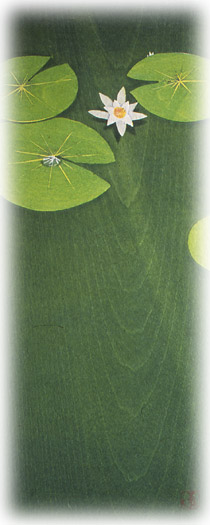
Suiren (water lily) |
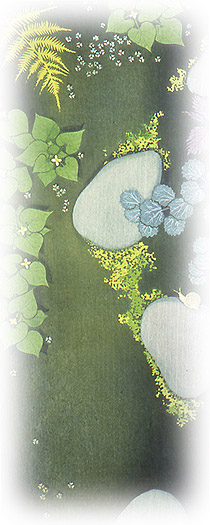
Sedo no kusa ("Grass in the backyard")
|
For
the exhibition in Paris, France commemorating the 150th anniversary
of diplomatic relations between Japan and France
"Hangiga" - Appeal of the flatland
Since woodblock prints known as "Ukiyoe" created
by Japanese artists such as "Hokusai " and "Hiroshige"
were brought into France 150 years ago, Japan and France have
shared a broad flow of art as represented by the significant
impact of Ukiyoe on many artists including Monet and Gogh.
"Hangiga" which will be presented in France for
the first time with this exhibition was created by me more
than 20 years ago by refining the traditional techniques of
Ukiyoe to create delicate and high quality woodblock prints.
Its most outstanding characteristics in addition to the expressions
of motifs and space, are the translucent and vivid colors
and natural texture of the wood surface, which remain on the
prints and which cannot be duplicated by other types of woodblock
prints or drawings. I think that it is a crystallization of
the components which play an important role in Japanese traditional
culture, which are wood, paper and water.
The quality of woodblock prints depends on the printing technique.
It is the essence which allows prints to come to life. Good
printing depends on various factors including weather, quality
and conditions of materials and tools such as Japanese paper,
woodblocks, paints, and "baren" (a tool for printing
woodblock prints), as well as physical strength and mental
conditions; if I can complete one satisfactory print per month,
it is a great success for me. It must be difficult in other
countries with different weather, different climates and different
history.
Since the birth of Ukiyoe, Japanese woodblock prints have
only been duplicates of Ukiyoe or copies of ordinary paintings
or so-called "creative" woodblock prints with poor
techniques. I believe that "Hangiga" will change
the recognition of such existing woodblock prints.
In the era when the global environment is in danger, we are
expanding the scope of our activities from three-dimensional
space to four-dimensional or even to five-dimensional space;
however, the appeal of drawing which is consolidated in the
flatland (two-dimensions) is still sufficiently mysterious.
The title of my exhibition, "Memories of Japan",
does not mean nostalgia, but "a form or shape of Japan"
which existed, still exists and will remain in existence as
a two-dimensional culture.
Last but not least, I would like to express my deepest gratitude
to the Japanese craftsmen who provide me with woodblocks,
Japanese paper, carving knives, brushes, baren and paints,
the people in Japan and in other countries who have supported
me by purchasing my works, Ms. Yuko Hattori of Espace Hattori,
Mr. Akio Uozu, a woodblock print critique, and the government
and =people of France.
May 2008 - Tsuzen Nakajima
During my three exhibitions starting from
the one in Seigetsudo Gallery in Ginza in March, the one in
Shimonoseki from March to April, and the one in Hirosaki at
the end of April which were held in less than two months,
I enjoyed warm support from many people. On this occasion,
we would like to express our sincere gratitude to all of them.
After I returned from Hirosaki after the exhibition in early
May, I felt a little tired and had some rest. Now I am totally
refreshed and am preparing for the exhibition in June in Paris.
I will report to you about the exhibition after I return.
At home in May with a balmy breeze.
|
Khorosho
rabota (good laborer)
I always remember a certain man whenever
it snows in Tokyo. It is Mr. Ando who worked as a janitor
at the National Institute for Japanese Language where I worked
as a part-timer for about a year after I graduated from my
university 40 years ago. He was one of the people who returned
to Japan from detention in a Siberian labor camp. He always
proudly told me like this. "I was called 'khorosho rabota
(good laborer)' by Russian soldiers". "khorosho
rabota" means something like "good labor",
and in short, means a "hard worker". He did not
have the gloomy atmosphere which was common to the people
who were caught up in the war and were forced to work hard;
he was a really cheerful person with a small build, and always
moved around. He often told me about his life in Siberia like
a good elderly father in a short story by Dostoyevsky when
we were alone together; "I was the best at digging holes.
I am so lucky because I can still work like this". When
there was a heavy snow in Tokyo in March, we shoveled snow
together. Young me was totally beaten by the tough "good
laborer" in the hard labor. I do not know what happened
to the "khorosho rabota". We do not have much snow
recently in Tokyo due to global warming which is fading like
a piece of my memories that fade away.
The same applies to our memories in history. Russia seems
to have drastic changes to be a wealthy state, but the northern
territories, which were stolen by Stalin like a thief at a
fire during the confusion immediately before our losing the
war 63 years ago, have not yet been returned to Japan. The
only occasion we become aware of this issue is when we hear
the news about seizures of Japanese fishing vessels by Russia;
it is terrible that the issue is getting out of our memories.
We can never beat tough Russians by using armed forces and
negotiations. The only possibility we can win is by using
language. I do not mean the Russian language. I mean to disseminate
the Japanese language thoroughly in Russia. We do not have
time to play with mobile phones. We cannot leave this to civil
servants and politicians who are "good loafers".
Mass media has just been chasing trends and we cannot rely
on it, either.
"The weaker the men, the greater they are miserably affected
by the superficial convenience in their lives" was a
wise comment about 150 years ago by Mr. Gertsen who was a
great Russian speculator in the 19th century. Viva, "khorosho
rabota"! I wish the people who work with sweat luck!
Incidentally, my exhibitions this year will be held in Ginza
and Shimonoseki in spring, and then in Paris in June. Some
people suggested that I have one in Russia, but I am worried
if my physical strength is enough.
On New Years' day in
2008 after having a dream decorated with a slight snow,
Tsuzen Nakajima
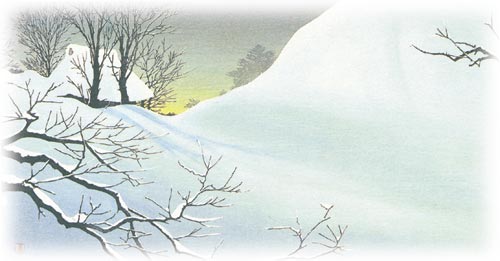 Bokyo (longing for the sight of home)
|
Becoming
a terrible wind
It seems that we can never stop the negative effects of TV.
50 years have passed since a famous Japanese critic coined
a phrase about all Japanese becoming idiots due to the bad
effects of TV, and that phrase became the phrase of the day
at that time. Now, we seem to be going further and we may
all become beasts. TV has become craftier about generating
delusions, fabrications, biases and misleading opinions. The
nation may indeed go to ruin without there even being a war.
We do not need any weapons to kill ministers. All TV has to
do is just to gather irresponsible, anonymous opinions of
the people on the street and from the people who are called
"intellectuals," and set fire. From the ancient
times, the Japanese have had a tendency to fuss about trivial
things which has led them to losing sight of the main topic.
Kafu Nagai, a famous Japanese writer, once said that the world
may become better or worse according to the level of the "wishes"
of females. "Watching TV makes us an idiot" - those
were the last words of Ms. Akiko Ikeda, a philosopher who
died in February at age 46. This is something we need to think
of as a the word of a philosopher.
One of the trendy things that has been popular recently in
Japan is a song in which the lyrics say that we become something
like a thousand winds after we die. It seems that the lyrics
say that we will become a wind after we die, but in mym opinion,
we will return to the soil and not become a wind. The Japanese
have been especially caring about the remains of the dead,
and have been carefully picking them up, arranging them into
the shape they were when they were alive to return them to
the soil. We do not treat the bodies like objects, and just
leave them, as is, in a hole. This is our culture and each
nation has its own culture. We have created graves even if
we only had wild chrysanthemums as materials, and recycled
all objects with a belief that everything has a soul. By acquiring
a convenient, throwaway culture, we are losing our long-established
thinking of carefully recycling all objects and our valuable
resources. We need to know that we lose two if we get one!
If things go on like this, global warming must become worse.
Now, it is autumn, the harvest season. I am worried about
the impact of global warming on the soil. How about the harvest
of rice and apples in your fields? I heard that our food self-sufficiency
has been decreasing. Cultivation is a very important job to
foster our food and soil (environment.) Now we have to think
more about self-support than liberalization. What saves the
earth is "self-support" and not love.
Incidentally, two types of calendars for the next year are
now ready.
Most of my works that are used in them are new ones. I hope
you will like them and have one around you.
In early September 2007,
before the equinoctial week, Tsuzen Nakajima
|
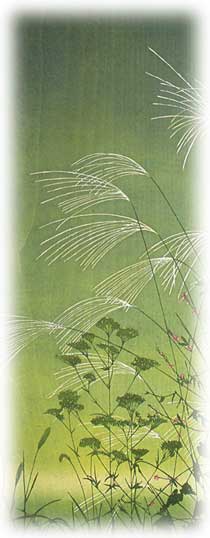
Hakushu (white autumn) |
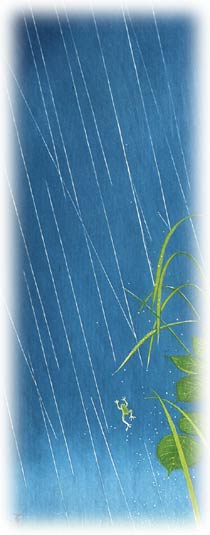
Hakuu (shower)
|
What
on earth is so "terrific"?
The Japanese language has been deteriorating
so terribly. Languages are the bases of nations and cultures.
It is a crucial situation for the Japanese culture which is
proud of the emperor and its long history as a sole ancestry
that is unique in the world. The media has been fussing about
"metabolic syndrome," and "spiritual,"
but they are just replacements for a "big belly"
and "emotionally manipulative sales techniques"!
There have been so many translations to conceal their true
motives, and finally, the Prime Minister started to use English
words such as "innovation," and "manifest."
How can he make Japan a beautiful country by corrupting our
national language?
Thanks to "democratization" after the war, the current
Japan has become an abnormal country represented by an increase
of parenticides. Recently, "corporatization" has
been added for globalization.
To begin with, globalization is just an event-oriented foreign
policy which disregards our own history, tradition and culture
in exchange for an efficient money making strategy. The event-oriented
culture has been trying to arouse our purchasing desires by
destroying our ordinary lifestyles. In such an era, war, politics,
elections and judicial trials have been taken up as events,
and the media and corporations have been fussing about how
to stand out in numerous events. Beefhead politicians say
that we must increase national holidays.
They do not seem to notice the subconscious mind in the world
which desires to calm down rather than to be activated. I
desperately hope that the young female TV announcers who are
used to events and do not know any acclaim other than saying
"Terrific!" wake up and read beautiful Japanese
poems such as the one written by Toson Shimazaki which beautifully
expresses about a young lady and apple trees every morning.
Incidentally, I had a one-man exhibition in Hirosaki which
is famous for apples at the end of April. The weather was
snow in the early morning with cherry blossoms in full bloom
at noon under the blue sky, and a full moon at night with
"Neputa" (floats used for festivals.) In rural areas,
local languages and festivals take hold in the peoples' daily
lives which make me want to shed tears. I told a seventeen-year-old
girl who works in a restaurant, "Please appreciate your
'Tsugaruben' (a Japanese dialect prevalent around the area
called Tsugaru)." She strongly nodded which made me so
relieved. The people in the Tsugaru area are earnest and hard
workers. I have become so healthy and haven't been caught
a cold since eating apples grown by those honest people in
their apple orchards.
In early June when apple
flowers are at full bloom Tsuzen Nakajima
|
Say
No to happy-go-lucky people!
The weather this winter was so strange probably due to global
warming. The woodblocks I use for my work were curved due
to the dry weather which caused me much trouble. I am sure
that other people who are in the field of manufacturing felt
this abnormality in their bones. During this time, happy-go-lucky
politicians, companies and media have just been focusing on
peace and welfare, meaning "gentle," "cute,
and "pitiful" things to them, they have not been
looking at the reality that, Japan and the earth are in an
unbelievable situation. Newscasters on TV with smiling faces
are always reading only happy news such as that about millions
of people visiting their hometowns or foreign countries on
consecutive holidays and summer vacations, but they never
tell us how much energy is consumed and how much emissions
and garbage are generated by their activities. Energy-related
problems and garbage-related problems have the same cause.
It is the same for problems concerning discrimination. If
we regard something unnecessary as garbage, it always leads
to bullying and wars. We had a concept of dirt which was called
"chiri" in ancient Japan, but we had no concept
of garbage. Forests of skyscrapers will be garbage, too, if
they become unnecessary. Unless we create a drastic rationing
system for our annual consumption of energy, there will be
no solution for global warming. I hope that such a policy
may increase our birthrate.
When I was in the third grade of junior high school, a student
who sat next to me (I will call him "T"), suddenly
muttered to himself, "Do you know who built the Horyuji
Temple?" during a social study class. Our teacher and
the other students did not know what to say to his sudden
question. Then he said "it was carpenters!" The
classroom was filled with laughter. T did not proceed on to
a high school, but succeeded his father's business, and became
a superior carpenter. To earn a living by ourselves must be
the happiest thing for us.
Incidentally, I am truly grateful to all of you who visited
my one-man exhibition at the Seigetsudo Gallery in Ginza in
March. Many visitors, including a lady who came from Kajima,
Ibaraki Prefecture after a 10-year interval and a person I
taught woodblock printing to 35 years ago, also came after
a long interval, and sent me a color copy of my old New Year
greeting card which surprised me very much. As I did not erase
their names on my list, I was rewarded with such happy reunions.
Such relations with people are so mysterious.
April 2007 on the birthday
of Buddha Tsuzen Nakajima
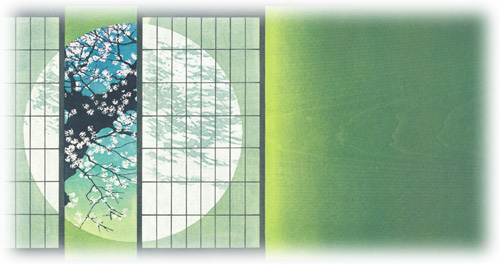 Ranman (Spring at its best)
|
Moral
jam-up
Recently, drink and driving has become a big issue. It does
not matter to me because I do not have a driver's license,
but I bet drunken drivers are car lovers. They like to drive
wherever they go. There is a department store close to my
place. A lot of people who live not so far from here come
by car, so there is always a traffic jam on weekends and on
holidays. Pedestrian crossings may not be safe. My apartment's
block is used as a byway, and they conspicuously drive through
at a high speed. Traffic signs such as "Slow" or
"No parking" are just useless.
The Setagaya Ward Office put signs up mentioning "Smoking
while walking and littering cigarette butts are prohibited
in this area" on the street, but they are ignored, too.
Smokers do not stop smoking on the street. They never fail
to litter their cigarette butts on the street. A vicious circle
of littering and collecting of cigarette butts does not seem
to end. I made a proposal to the ward mayor about this a half
year ago. "Why don't you use senior citizens to work
as walking signboards in a costume of a cigarette butt at
an hourly rate basis?" An official gave me a polite call
about my proposal, but they haven't done anything. It is the
same about unruly parking of bicycles on the street. Public
officials and companies uselessly glad-hand and give cosmetic
answers, but do nothing constructive.
Banks do not imagine how many people visit them to withdraw
or send money on December 25, and only have gentle-looking
clerks handle customers gently, and keep customers waiting
endlessly. Teller windows are closed exactly at 3 o'clock.
After that, they charge additional fees for transfers and
withdrawals. Banks make a lot of money, so why can't they
open teller windows on weekends and at night as weekdays?
But they do not intend to do that. Signboards and a recorded
voice will answer customers after 3 o'clock. What is the source
of their defensiveness and arrogance? Furthermore, politicians
and media do not see reality which is hidden by advertising
agencies' superficial recognition. I am afraid how long Japan
will last in such a situation. The New Year started with degradation
of our senses and a moral jam-up!!
Incidentally, what is your opinion about the new Kakejiku
calendar for 2007? It was designed by a young designer, Ms.
Akiko Iyoda. I am truly grateful about the heartwarming letters
and mails which were received from home and abroad. I did
not create desktop calendars this year because I was too occupied
on miscellaneous things in Japan and in other countries to
concentrate on the creation of works. I am going to create
both types of calendars for the next year. I hope you will
like them.
My next exhibition will be in March before we have cherry
blossoms at Seigetudo Gallery in Ginza. Please come to see
me there.
At the beginning of the New Year before the exhibition in
spring.
Tsuzen Nakajima
|
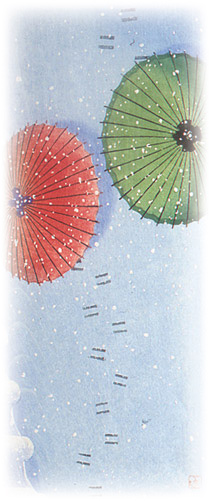
Yukitagai |
The
situation of mobile phone users
I find mobile phone ("ketai") users often look blue.
It does not seem that the huge mobile phone charge deprive
them of enough money to eat decent food, but everyone looks
pale. 70% of the people who are sending mails by mobile phones
on the trains are females. They do not appear energetic. The
babies who are with them do not have flushed cheeks. Apparently,
male mobile phone users do not look satisfied with their jobs.
I do not have a mobile phone or a personal computer. I do
not have a fax machine, and my TV is broken, so people treat
me as an odd person. I just do not need to have them because
they do not seem interesting to me at all. These kinds of
equipment are certainly convenient and simple, and may save
me troubles, but on the other hand, I feel they are a form
of "cheap" convenience. I think buying products
directly from people in the field and writing them letters
is much richer, and we think many things when we do these
things. Troubles in the world are interesting and atmospheric
because they take time. My mother often told me, "Do
not follow trends!"This is the wisdom of Edokko (the
people who were born and raised in Tokyo by families who have
lived in Tokyo for three or more generations.)
The other day, I went to buy woodblocks after a half year
interval. I was told that the shop could send them to my place
the next day, but as usual I carried them in my hands even
though it caused much difficulty when going up and down the
stairs in the subway stations, and sometimes almost being
kicked by other passengers. I have been doing the same for
more than 40 years. As you can imagine, it is getting harder
and harder for me, and it takes me a while before I can catch
my breath. I always think like this when I carry woodblocks
with me. "Why on earth have I become a woodblock print
artist?" It has been a while since I started to tell
myself that I would be in this field throughout my life. I
am happy because I am still able to carry woodblocks by myself.
Recently the press started to say that they should go and
look at the field, but it is just a principle. Even if we
look around the field where people are struggling and living
in poverty, it is impossible for us to understand their feelings
without actually being in their position. It is a real self-education
in the field. I think this is what we call "life in the
field."
Now the world is covered by an invisible field. It is an electromagnetic
field! I hope that the electromagnetic waves from mobile phones
and ticket wickets at stations do not relate to the increase
of ademonia (depressive psychosis) and a decrease in the birthrate.
On this occasion, I would like to express my deepest gratitude
to PHP ahd Mr. Takao Yoshino, the Editor-in-chief, for using
my works for the whole year on the covers of the monthly magazine
"Voice." Again, it's time for calendars for the
next year. It is a little early, but I wish you a happy New
Year!
November 2006 - On the
occasion of the sale of new calendars - Tsuzen Nakajima
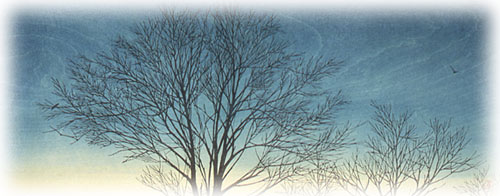 Fuyuki (winter trees)
|
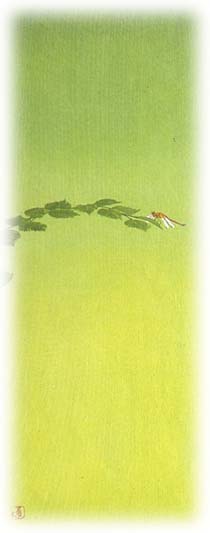
Akatonbo (Red dragonfly)
|
Divine
power
When the week of the equinox approaches,
I always remember my father who was a Buddhist monk. My father
had a kind of divine power, and he brought down a B29 of the
U.S. Army with his willpower. I knew of many more mysterious
experiences concerning him including his not being harmed
at all when he was hit by a car, and when he visited a shop
with no customers, soon many people came.
Until several weeks before he passed away, he never failed
to read a sutra every morning and evening. He also made me
pray every morning and evening at a Buddhist altar, and asked
me to clean a Buddhist altar and a Shinto altar every day.
My father habitually repeated these phrases. Never fail to
take care of your Buddhist and Shinto altars. It is no use
praying to the Buddha and Gods just for a day or two. If you
pray for them every day without fail, and if you are lucky,
the Gods and Buddha will accept your wishes. At this age,
I know that my father's sayings are applicable to the job
as a craftsman like me. If I take even a day off, my skills
will surely become rusty.Divine power comes from extraordinary
efforts which can be done by ordinary people. That means keep
on doing what you believe every day without fail!
It is the same for all the commotion about the visit of Prime
Minister to the Yasukuni Shrine. It's so ridiculous to have
such a big discussion about whether we agree or not with his
visit of only once a year. Both sides that have such a ridiculous
discussion make a fool of the Gods. I would like all the numerous
"so-called" commentators, politicians, mass media,
and the governments of China, Korea and Japan to have their
say after they pray for Gods 365 days in a row without fail.
If a war begins by such a difference of views, it is a real
bad karma, and if there is no war, we should be grateful to
the Gods for answering our prayer. I think this is what we
call "religious faith."
In Japanese, "kami" which means Gods, also means
"paper" which represents what is essential to us.
We have been having honoring for Japanese paper which is essential
to woodblock prints. "Kami" is a mirror which reflects
our mind, and we know if a specific era was good or bad by
looking at the papers which were produced during the period.
If the era had much turbulence, the quality of papers deteriorated.
How does the Japanese paper which was created in this era
reflect our times? I have to leave it to the judgment by the
people of later ages. Paper is not the only item which reflects
the time. So do females. I wish that sophisticated females,
like chic and robust hand-made Japanese paper in the Edo and
Heian Periods which do not deteriorate, will not decline in
number in comparison to an increase of females like bleached
toilet paper.
Incidentally, the calendars for 2007 featuring my works are
now ready. They came out very well. I hope you will like them
and have one for display near you.
Looking at ears of rice
in September 2006 - Tsuzen Nakajima
|
At
Tanabata (Star Festival)
When I went to a nearby bookstore, I noticed that a young
lady enthusiastically entered texts on her mobile phone from
a brand-new title which she held open in her hands. Being
unable to stand by as a former editor, I said "it is
an act of stealing," but it only resulted in her staring
at me with a questioning look. Today, again, I heard news
that cherries which were just before harvest time have been
stolen in Aomori Prefecture. Where has our sense of justice
gone? Don't you ever see how hard working self-employed individuals
who sweat to create and trade products from their own work
only gain a small amount of profit?
Shoeki Ando, a philosopher from the Tohoku region in the middle
of the Edo period, did not appreciate anyone including Buddha
and Jesus Christ who only dwelled on the virtues without actually
working up a sweat in the mud to produce crops. We can boast
to the world that he was one of the greatest men ever.
Talking about sweat and mud, our current educational system
really seems to be in the mud. Since the ancient times from
the Edo period, the basis of Japanese education has been reading,
writing and calculation by using an abacus, but I think it
is better to include sumo. Sumo should be one of the basic
elements of our education. Sumo seems to be a simple sport,
but in fact, it is very profound in nature. It is a type of
sports where athletes sweat in the mud standing barefoot and
naked and without weapons on the Dohyo (sumo ring) which represents
the shape of the Sun. There is no room for trickery, and there
is no one to rely on except ourselves. By fighting in such
a situation, we can realize the strengths and the weaknesses
of ourselves and others through our own experience directly
from the match. There is no room for quibbling. Immediately
after the winner and the loser are decided, the barrier between
the friend and the foe is gone. Both fighters let themselves
down, and the fight ends by bowing to each other. There is
no room for an evil mind to sneak in. Where on earth can we
find such a culture in the world?
I can say that the young people, more specifically, young
men are full of fear, timid and sometimes cowardly because
perhaps they did not become familiar with sumo when they were
children. It is best for them to have a Bon Festival Dance
and sumo competitions together on school yards or on the field.
I am ashamed to say, but I, who am small in stature, had the
experience of being awarded a set of crayons when I beat five
persons in a row during a sumo competition which was held
in summer in the town where I lived when I was in the first
grade of elementary school.
By the way, I upset my health probably because of accumulated
fatigue since last year, and I gave up my plan to visit London
and Hirosaki, and actually had to return from the boarding
gate of Narita Airport. I do not have any plans for exhibitions
this year, so I am going to refresh myself.
The calendar for next year will be in a little different style
from the previous ones. I hope you will like it.
At Tanabata (Star Festival)
in July 2006 - Tsuzen Nakajima
|
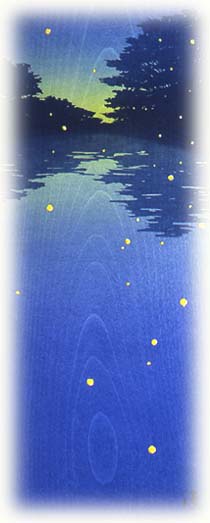
Firefly |
Before
the exhibition at Tamagawa Takashimaya
Thanks to the courtesy of Ms. Makiko Uchidate, a scriptwriter, I
went to see sumo at Kokugikan in Ryogoku after a long interval on
May 15. I became nervous when I sat in the seat called the "sunakaburi"
which was located on the front side and was very close to the "dohyo"
(sumo ring). Looking at the efficient movements of the "gyoji"
(judge) and the "yobidashi" (persons who call out the
names of sumo wrestlers before each match) and imagining the mental
conditions of the "rikishi" (sumo wrestlers) by watching
their serious faces before the match, I was moved to tears.
Many sports in the world are for competing to win, and it is not
very interesting for me to watch them without having any athletes
or teams to support, but when I watch authentic sumo matches at
Kokugikan, I have never felt that way. I think sumo is a sport with
which we can fully appreciate sophisticated traditional beauty which
has been fostered in Japan, and the skills and characteristics of
each sumo wrestler.
It is said that the popularity of sumo has been decreasing recently,
but I do not think that it is because of the advancement of "gaijin
rikishi" (foreign sumo wrestlers.) As long as rikishi, gyoji,
yobidashi, the Sumo Association, and the society of sumo-related
craftsmen try to maintain our good old tradition, we do not have
to worry about its future. I think the problem is on our side. It
also applies to art, and if the audience is serious, athletes and
artists do a good job. But recently, many of us watch sumo and arts
only on TV, so we tend to focus on a facade such as who wins or
loses or superficial beauty which can be easily recognized on TV.
TV, and thosoe of us who only watch sumo and view arts on TV should
be blamed. If we would like to protect the authentic, we have to
go and see the real sumo and real arts sometimes. That's the only
thing we can do.
It is the same about the interest and preferences in foreign cultures;
from my small amount of experience, people in the United States,
England and Australia who became fond of Japanese culture were those
who saw the real Japan.
Recently, we tend to evaluate things which can be expressed in numbers
or just a facade, and people try to become confident in themselves
by maintaining good numbers in such areas as incomes, audience rates,
support rates, the decrease in the number of children and so on,
but numbers do not prove anything. They are only the virtual reality
and virtual values, and not the authentic.
Recently, our society tends to appreciate "new" more,
and disregard "old," but as another pronunciation (koi)
of the kanji which represents "old" describes, "old"
is not just old, but means "rich."
May 2006 - before the exhibition
at Tamagawa Takashimaya - Tsuzen Nakajima
 Shokei (adoration
At
the earliest spring in March 2006
Various types of people visit my exhibitions. Some people never
come regardless of how frequently I send them notices, but mostly
I have long-term and marvelous relations with the people who became
acquainted with me by chance.
A young male police officer who happened to know me six years ago
came to the exhibition in February with his colleague after a long
interval. Both of them are age 26 and single. They have good postures
even while off-duty which clearly indicate their good nature. I
heard that they have limited chances to meet women, and many of
them get married either with female police officers or nurses of
police hospitals. Are there any ladies who are going to be the brides
of such nice guys?
On the first and fourth day, Ms. Mariko Iwata of ANA Learning, which
is one of my good supporting companies, came with her subordinates.
The whole atmosphere in the long and thin shaped gallery changed
gracefully as if we had been on an airplane. Now she works "on
the earth" as an instructor of services and speech for various
companies and clinics. I really feel that this kind of job is very
important in this era because we tend to forget about the importance
of good manners.
On the first day, Mr. Soyu Itami who is an instructor of the tea
ceremony of the Urasenke School gave me a chic greeting. In the
same evening, Ms. Makiko Uchidate, a scriptwriter, came and said
she liked a small work that I thought nobody would pay much attention
to. Later on, I told her, "The small work you liked was very
popular. Even with such long-time experience as mine, it is still
difficult to read people's mind," and she had a big laugh.
At the last minute of the last day, a 30-year old ex-employee of
a big trading company who said he was cheered by my works which
were exhibited at the Furusato Bijutsukan came, and told me that
he was going to establish a company in Kyoto. I am happy that I
have come to have another good relation.
Incidentally, a doll we used as a decoration at the venue attracted
attention. It was made by Ms. Harue Fujikawa, a clay artist. She
is young at 34 years old. I believe she is a one-in-several-decade
talent. Please cheer for her.
http://www.haruefujikawa.com/
My exhibitions seem to have become somewhat routine, but I'm going
to continue as long as I have visitors who come to see me, and I
have enough energy to see them once a year.
Last, but not least, I would like to thank all of visitors who came
to see my exhibition in such cold weather.
At the earliest spring in March
2006 - Tsuzen Nakajima
 Kunpukaisei (balmy breeze in a fair weather)
|
At
the beginning of the New Year
I was very amazed at the unexpected number
of reactions from various people regarding my exhibition which
was held at the end of last year in Sydney. I had a lot of
visitors who live in Australia, but surprisingly, there was
a young lady who knew about my exhibition when she flew with
Qantas Airways and came to see it from as far away as Virginia,
US. During the opening event, Mr. Tsukasa Kawada, Consul General
of Japan in Sydney, and Mr. Leigh McClintock, President of
the Japan-Australia Society made detailed presentations which
covered a wide range of topics from culture and history of
Japan and Australia to my "hangiga," which beat
me at my own game.
I was especially surprised to learn that there were Australian
people who became interested in Japan and wanted to visit
Japan after visiting my exhibition, and I learned this after
I returned to Japan through a letter I received from Ms. Shoko
Ohno who played koto at the venue and Ms. Mieko Fukakusa,
a calligrapher. I also heard that there were Japanese people
who felt like returning to Japan, and who would like us to
organize another exhibition again soon, because they missed
the one last year. These comments made me feel a little embarrassed,
because I thought that Australia was the best place to live
with friendly people and a comfortable atmosphere. This year
falls on the 30th anniversary of Japanese-Australian formal
relations, and another exhibition is being planned in Sidney
in May, but I have not yet made up my mind, because I am a
little worried if I have enough strength to create enough
works by then.
Last, but not least, I would like to express my sincere gratitude
to the staff of JAL and JALPAK who took care of our round-trip
and accommodations, Mr. and Mrs. Azuma of the Japanese restaurant
"AZUMA," who served us superb cuisine everyday,
KIRIN in Australia which offered us a huge amount of beer,
reporters of the NICHIGO PRESS, and members of the Toumonkai
who are active in Australia. I am also truly grateful to Joe,
the owner-director of the gallery, Rachael, the gallery curator
& manager, Ms. Yoko Aizawa Carr and Ms. Haruko Sumi from
the Opal George who gave me strong support.
I have another exhibition at the Seigetudo Gallery in Ginza
starting from February 7. Please come and join me at ease
with a glass of wine! It seems that this winter is so severe
for the people in Sapporo, Hirosaki, Sendai, Toyama and Shimonoseki.
Please take good care of yourselves. I am looking forward
to seeing you again soon.
Starting from the January issue, my works will be used for
the covers of the monthly magazine "Voice" in 2006.
Please take a look when you see the magazine at a book store.
At the beginning of the New
Year - Tsuzen Nakajima
|
In
Tokyo on a warm autumn day
It is amazing that the government has given us so many consecutive
holidays. After three consecutive holidays, we never fail to see
a lot of long queues at hospitals, banks and post offices. Nowadays,
people move between shopping and entertainment districts and their
homes differently; a lot of people go downtown on holidays, but
downtown turns into a ghost town on weekdays. Politicians have always
been yelling "Reform! Reform!" since ancient times, but reform always
creates new corruptions. All through the ages, politicians can only
create more holidays, or black markets or swings and roundabouts
at the best.
I remember when the company I worked for went bankrupt 31 years
ago; the company and the labor union were only talking about reform
then. It seems that the Japanese tend to be too attracted by words
like "reform" or "innovation." It is helpless, because we may forget
about other things when we listen to these words, afraid that we
may fall behind the times even if we actually do not want any reform.
After all, true reform is self-reform. Conveniences and technical
innovations only contribute to create more hustle and bustle in
the world, and do not have any impact on our true nature. After
all, stupid people are stupid and naughty people are naughty, and
reform cannot change them. It is beyond all help, because the tendency
that we are too attracted by reform is getting worse.
I noticed that when I visited the United States five and a half
years ago for the first time. The United States won out over Japan,
but the only thing they went under Japan was education. They felt
really frustrated, and have intellectuals in various fields analyzed
Japan and the Japanese, and the result of their "reform" is our
current "yutori kyoiku (education free from pressure)." Now, both
pairs of pants and the academic skill of the young Japanese are
slipping down, and they bleach their hair which leads to an awkward
style.
I will have an exhibition from November 10 to December 4 in Sydney.
I will report to you about the exhibition later.
In Tokyo on a warm autumn
day in 2005 - Tsuzen Nakajima
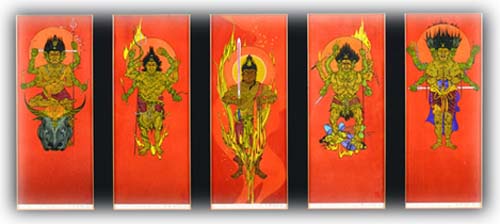
 |
Listening to the chirping of
autumn insects on "Nihyaku-tooka" (the 210th day
from "Risshun" (the first day of spring))
My 101 works are now being exhibited at
the Furusato Bijutsukan, Asahi Town, Toyama Prefecture until
September 25. I visited Asahi Town on the first day of the
exhibition, July 22.
I was very surprised at the big welcome from all the people
including Mr. Ryuichi Uozu, town mayor, townspeople, and media,
and am deeply grateful to them.
I would especially like to express my sincere thanks to Mr.
Akio Uozu, who accepted all the troubles related to the planning,
exhibition and receipt of visitors at this exhibition.
I have known him for as long as 20 years since he gave me
significant support when he ran a woodprint shop in the Yaesu
Book Center located inside the premises of Tokyo Station.
Several years ago, he returned to Asahi Town, his hometown,
to sum up the results of his research, and exerted himself
in the opening of the Furusato Bijutsukan.
Different from the many monotonous architect-oriented art
museums which prevail in Japan, this art museum uses a wooden
residence which gives us a warm and soothing impression. I
believe his way of operating exhibitions which cannot be made
by ordinary museum attendants who only know textbook-like
methods depends absolutely on his deep insights on artists
and visitors as well as art works he acquired through his
experience in publishing and sales over the years.
I admire his acute sense fostered through his long years of
experience, because we have more and more commentators who
have nothing but know-it-all attitudes with no on-site experience.
I will probably not be able to have an exhibition with such
an amazing way of exhibition at such a marvelous venue anymore.
If you have time, please visit there by getting off at Tomari
Station of the Hokuriku Honsen Line. There are a lot of things
you can enjoy in the town, such as comfortable Japanese style
hotels with hot springs, the beautiful ocean, mountains and
delicious rice.
Incidentally, my postcard calendars for 2006 have been completed.
I will have an exhibition for about a month in Sydney in November.
I have been trying to compensate the decline of my physical
strength with my mental toughness. Regardless of the changing
of times, like other people, I probably am the type of person
who understands myself least.
Listening to the chirping of
autumn insects on "Nihyaku-tooka" (the 210th day
from "Risshun" (the first day of spring))
- Tsuzen Nakajima
|
| At the Vega Festival in 2005
After the new collection of my works was published in May,
I have received many letters from many people. Postal mail
is my only communication method to receive reactions to
my works, because I do not have a PC, or a mobile phone,
and do not have an access to the Internet.I especially feel
attached to hand-written letters, and I frequently read
them again at night at my bedside, and go to send my replied
to a post box.
It is completely my self-applause, but after I sent my new
collection to Ms. Makiko Uchidate, a scriptwriter, during
Golden Week, she sent me a hand-written thank-you letter
telling me that "Tsuzen-san, your new collection was
so terrific, and just so amazing! I feel ashamed that I
can only think of such ordinary praise in spite of my profession..."
I feel really grateful to have such great praise.
I have known her since I met her during a job for NHK after
she wrote a famous drama series "Oshin." So our
friendship has continued for more than 20 years. We have
never talked to each other on the phone, but have always
been exchanging hand-written letters. She is "amazing,"
too, because she has never broken her style by sending me
only her hand-written letters even though she has a very
busy schedule. I truly hope that she will educate Japanese
people what the true Sumo spirit is through her assignment
as a member of the Yokozuna Promotion Council, and would
like the people in the sumo world and our nation to tighten
up our loinclothes turn over a new leaf without being moved
by immediate trivial things.
In connection with loinclothes, my work titled "Uminoko
(Children of the Ocean)" in which I showed boys running
on a beach with red loinclothes about 20 years ago had never
been sold before, so I felt so happy when the members of
the Beach Boys came to my exhibition two years ago during
the Sakura Festival in San Francisco, and bought that work
telling me that they were going to make it as their symbol.
It was wise for me not to throw the wood blocks for the
work away. The Beach Boys reached milestone in the history
of rock music similar to the Beatles, and are almost the
same age as me, so I am very impressed that they are still
so active now. I read in the Sankei Newspaper that they
are coming to Japan after a 14-year interval. I am going
to listen to their records at home.
I will have an exhibition for two months from July 22 at
the "Furusato Bijutsukan (Hometown Art Museum) in Asahi
Town, Toyama Prefecture. If you have a chance, please visit
and take a look at "Uminoko" which will be exhibited
for the first time.
At the Vega Festival in 2005 - Tsuzen Nakajima
|
|
|
At the end of Spring
I am sorry that I could not see even one bud of cherry trees
open in Hirosaki during my exhibition at the end of April,
because the cherry blossoms were a little late than usual.
But the female taxi driver on my way to the Aomori Airport
on my return trip made my heart warmer. She seemed almost
as old as me. She mentioned she wanted to become a taxi driver
when she was young, and finally got into the business 15 years
ago. She said she was happier than ever everyday since then.
About a 40-minute driving went by so fast with our happy chat.
Meeting such people who really love their job makes me so
happy. Such people drive safely, and they make others happy
by just their existence.
I often go to the Meijiya grocery store for my daily shopping.
It is the best shop for a person living alone, because we
can buy good food in a small amount without being worried
about having leftovers.All the staff at the shop work very
crisply, and never give a dirty look regardless of whatever
customers ask. They look very elegant during work, and I feel
that they make the food I buy there more tasty.
It has been mentioned by many people, but I recognized anew
that the most important thing in business is the character
of people.
At the beginning of the cherry blossoms in Tokyo, I saw the
Noh play "Kumano" performed by Mr. Reishi Okamoto
after a long interval. He sent me an invitation, but I bought
a ticket as an ordinary member of the audience, and they gave
me the best seat. There were a lot of ladies who dressed up
beautifully around me. I could not help but shed tears at
his magnificent and subtle expressions, but a lady who was
armored in brand goods snored in her sleep in front of me.
It is said that we are in a bipolar era, but the bipolar trend
is not just in terms of wealth, but of our brains.
My second collection was published on May 10. Please take
a look.
Tsuzen Nakajima, in May 2005 at the end of Spring
|
Before my birthday
The exhibition at the Seigetsudo Gallery in early February
was held in Tokyo after a two year and two months' interval.
Different from the ones held at department stores, the atmosphere
for the whole week was very family-like, and evoked my great
sense of gratitude. I am truly grateful to all of the visitors
and staff for their kindness. I am thinking about having another
exhibition at the same gallery next year. I hope to see you
in good health again, and to have a nice chat.
On such an occasion, I always feel my deep ties with other
people. One of the visitors said to me, "All the visitors
to your exhibitions were born again to come to see you after
a 600 years' interval, and all of them lived together then."
Such a comment gives me a comfortable sense of tension. After
celebrating my 60th birthday last year, I feel like accepting
all visitors, and I cherish the chance to meet people as frequently
as possible. If you have time, why don't you come visit me
and have a nice talk and drink with me? People retire at my
age, but it seems to be the contrary with me. Unfortunately
it was after my exhibition ended, but Mr. Jonathan Warr, who
is one of my good supporters, came to my house in the middle
of February from England. I was really happy to find that
he loved Japanese sake. On New Year's Eve, Dr. Ko Sasaki,
who is a dentist living in Nishi-koyama, came to give me a
record player shaped like a gramophone. Since then, I picked
out my favorite old LP records from a closet, and played them
during my work every night.
Tonight, my selection is Brenda Lee and Mieko Nishijima, a
Japanese pop singer.
At the end of April, I will have another exhibition in Hirosaki
during the Sakura (Cherry Blossom) Festival. A new collection
of my works will be published by Nichibou Shuppan Publishing
in May. A big exhibition is kindly being scheduled for me
for two months from July 22 at the "Furusato Bijutsukan"
(Hometown Art Museum) in Asahi Town, Toyama Prefecture. I
am looking forward to your visit!
Tsuzen Namajima, in March 2005 before my birthday
|
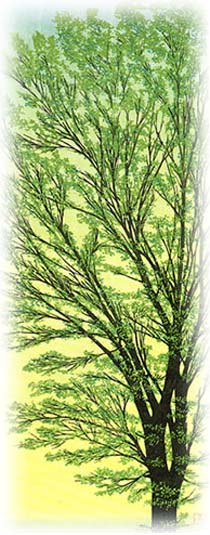
|
In autumn with fragrant orange-colored olive
In early summer, I went to the Edo-Tokyo Museum to see the
old chadansu (chest) my family owned, which is now displayed
at the museum, to get an idea for next year's calendarWhat
amazed me a lot was the top-heavy, inorganic appearance of
the building, and its superficial exhibition space which looked
like a set used for shooting of TV programs. I had no idea
how to escape this building in case of an emergency like an
earthquake or fire, so I rushed out of the museum after staying
less than 15 minutes.Ryogoku, where the museum is located,
was severely damaged by catastrophic fires including one in
the Edo Period, the Great Kanto Earthquake, and the air raid
on Tokyo.The windowless building made me think that the building
might make me die there in a fire like the ones they had in
the past. In the first place, the people who built such a
building did not understand the beautiful taste Edo had, and
good old Tokyo had. I dare say they didn't like Edo nor the
good old Tokyo. They did not actually feel the "taste"
in their own lives.The biggest characters of Edo and good
old Tokyo werthe alleys and water channels. I really regret
that they could not have kept more alleys and water channels
untouched instead of building such an inorganic building.
For a change, I got off the train at Sakura-shinmachi Station,
two stops before the station closest to my house,and went
to the Hasegawa Machiko Museum established by the popular
Japanese cartoonist Ms. Machiko Hasegawa who was famous for
the character "Sazae-san."There were no visitors
except me, but the place made me feel better.
"Sazae-san"
was one of the most popular Japanese cartoon characters from
the post-war period, and still is. I saw Ms. Hasegawa on the
streets, but did not have a chance to meet her personally.She
seemed to be a typical traditional Tokyo person, who are shy
and do not like to distinguish themselves too much. She was
really famous, and her works were so impressive, but she had
not received any noteworthy prizes like the Order of Culture,
or the National Medal of Honor. That fact made me very surprised,
but at the same time, made me realize she did not like bureaucracies.
Sometimes I see the "Sazae-san" cartoons broadcast
on TV. I think her greatness was that she did not change her
lifestyle and life cycle even after she became so famous and
popular.
A little walk from the museum got me to the temple where a
monument built in remembrance of Ms. Chiemi Eri, a singer
who became famous by for recording the "Tennessee Waltz"
and also famous as a voice actor for the "Sazae-san"character.
I visited her grave and the monument before going home.
In November, I will finally visit Washington D.C. for my exhibition
at the House of Representatives' library, which was postponed
for so long due to fear of another terrorist attack and so
on. I am going to listen to the authentic Tennessee Waltz
in the United States.The severe heat this summer was so terrible.
It dried my paint, and bent the wood.I don't use an air conditioner
during my work, so you can imagine how hard it was.Please
see the achievements in the calendar for next year.
In autumn with fragrant orange-colored olive - Tsuzen Nakajima
|
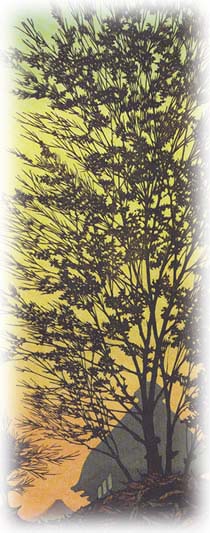 |
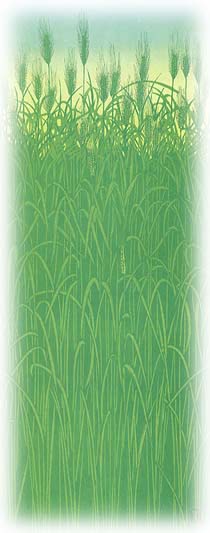 |
On a day close to the Greenery Day
In January 2004, the wife of the shopmaster of the Kaneko
Shoten in Moto-Asakusa from which I have been buying bamboo
leaves for my "baren" (a tool used for woodblock
prints), sent me a letter to inform me that she would
close the shop because of the sudden death of her husband.
Five years ago, Mr. Itakane, who made printing blocks
and lived in their neighborhood, died and his wife and
daughter came and advised me of their giving up the business
which had been operated since the Edo Period. It's sad
to see businesses with such long histories go away one
after another, and I feel that it becomes more and more
difficult to keep doing my job the way it used to be.
It is a very big issue for me to lose such shops. I like
shops run by couples. Whatever they deal with, fish or
fruits, shops mainly kept by couples usually do business
fairly. They have taste, substance and heart, which cannot
exist with mass merchandise outlets or large companies
which only seek better sales and efficiency.
They have life in its original meaning, where the job
and life are merged into one, which maybe called culture.
Many people have been lifting their voices loudly to help
us realize the significance of our culture and tradition.
But, originally, our culture and traditions have been
grown in our ordinary, routine lives in a slow pace, which
I feel in such businesses. The present situation is that
we are in a dangerous point where our "ordinary"
traditional culture is being destroyed by speed-oriented
performances and events.
By the way, I became sixty in March. This means the end
of the traditional sexagenary cycle. I have been working
with woodblock prints for 44 years. I cannot leave my
work to other persons, so I have to give it up if I become
short on physical strength. If I can complete one satisfactory
print per week, it is fine with me.
Thanks to the assistance from Mr. Jun-ichi Kamiyama, a
DVD was released on April 10. I'm sure you will enjoy
his beautiful music. An exhibition is scheduled in Washington
in the autumn of this year. If I am given an opportunity
to talk to the President, I would like to tell him about
the relationship between Japanese traditional culture
and our daily life.
Tsuzen Nakajima - On a day close to the Greenery Day
|
|