|

”Hangiga (literally “a drawing created
by woodblocks”) is the name I coined to refer to my woodblock
prints.I would like to mention that the word really means something
like “a drawing created by the carving and the grain texture
of the woodblocks.” Basically, the method of handwork and
the material I use are the same as those used for “Ukiyoe
(Japanese traditional wood block prints),” but I do all the
steps myself, from drawing a rough copy, carving the design on woodblocks
and printing.The biggest difference is in its printing method, which
is the most essential factor to create unique woodblock prints.
The translucent and vivid colors and natural texture of the wood
surface, which remains on my prints, have been created through my
many long years of experience.One of the questions most frequently
asked by visitors to my exhibitions in London and San Francisco,
as well as those in Japan, is how could I print the texture of the
wood surface on my prints. It is created by a complicated and subtle
combination of materials, equipment, climate and my mental status,
and it is very difficult for me to explain about it briefly in words.If
I can complete one satisfactory print per day, it is a great success
for me.” (From the collection of his woodblock prints “Kokoro
ni nokoru Nihon no Omokage (Unforgettable Memories of Japan)”
published by Nichibou Shuppan Publishing)
The grain’s woody texture and translucent colors can only
be created by the method I use with woodblocks, and not by traditional
ways used to print woodblock prints or lithographs.Even with my
method, woody textures diminish after printing about 30 prints per
block, and I cannot create so many prints from one pair of woodblocks.
Another frequently asked question is about the motifs and structural
outlines of my prints. All of them are based on my memories of my
life in Tokyo, Japan since my childhood. So, I used the title “Memories
of Japan” for the book.I do not intend to create my works
about nostalgic images. I have been using such motifs, because I
believe the landscape and atmosphere I described in my works still
remain in our daily lives, and they will also remain in the future.
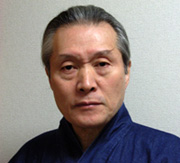 |
Tsuzen Nakajima
------------------
Born in March 1944.
His family had been living in Asakusa, Tokyo for generations
(such a person is referred to as "Edokko" in Japanese,
which literally means "a person from Edo (the former
name for Tokyo)"). His father was a Buddhist monk, and
mother the daughter of a lacquerer. Graduated from Kitazono
High School, a Tokyo metropolitan government-run high school,
he completed the Art Program in the Literature Department
of Waseda University.
Nakajima started to create woodblock prints when he was 16
years old. After several jobs including one for a publishing
company, he established a method to create his unique woodblock
prints, which he calls “Hangiga,” with translucent
colors and a wood grain texture.
As a genius who opened a new way for creating woodblock prints
beyond the traditional Ukiyoe, his works have drawn attention
in various countries including England, the United States,
France, Spain, Germany, Austria and Australia. |
| ■August 1999 |
Appeared on the radio program “Ikiiki Club” on NHK radio (rebroadcast on June 19, 2000) |
| ■April 2000 |
One-man exhibition at Sakura Festival in San Francisco. |
| ■May 2001 |
Invited to "JAPAN 2001" in England, and held a one-man exhibition in London as an artist representing contemporary Japanese woodblock print artists. |
| ■2002 |
Held a lecture at the Bureau of Engraving and Printing, Ministry of Finance. |
| ■April 2004 |
DVD “Nihon no Omokage (Memories of Japan)” (Music by Joseph Kahn, Woodblock prints by Tsuzen Nakajima) released by Pioneer |
| ■May 2005 |
A new collection of works "Nihon no Omokage - Iki (Memories of Japan - Japanese chic)" was published by Nichibou Publishing. |
| ■July 2005 |
Held an exhibition at the Furusato Bijutsukan in Asahi Town, Toyama Prefecture. |
| ■November 2005 |
Held a one-man exhibition at the Global Gallery in Sydney, Australia. |
| ■2006 |
His works were used for the covers of the monthly magazine Voice published by PHP. |
| ■ June 2008 |
One-man exhibition commemorating the 150th anniversary of diplomatic relations between Japan and France at the Centre Culturel Franco-Japonais in Paris. |
| ■ September 2008 |
Organized a one-man exhibition as the first for a Japanese artist in the Chateâu des Bouillants organized by Dammarie-lès-lys, commemorating the 150th anniversary of diplomatic relations between Japan and France. |
| ■ September 2010 |
One-man exhibition at Espace Japon organized by OVNI newspaper. |
| ■October 2010 |
The second exhibition in the Château des Bouillants organized by Dammarie-lès-lys. |
| ■November 2010 |
Participation in Laudun - Le Japon Maitre des Arts organized by Laudun as a guest artist. |
| ■December 2011 |
Awarded Silver Prize at the Exhibition at Carrousel du Louvre by Société Nationale des Beaux Arts. |
| ■July 2012 |
Became a member of Société Nationale des Beaux Arts. |
| ■November 2012 |
Awarded the Mayor of Saint-Maur's award which is given to the most superb artist by Saint-Maur City, France. |
| ■October 2014 |
Awarded the Mayor of Grez sur Loing Award at the "Arts en val de loing" exhibition
(Grez sur Loing is famous as a village of artists throughout the ages). |
| ■June 2015 |
Exhibition sponsored by the Japan Foundation and the Japanese Embassy at the Hanenko Museum in Kiev, Ukraine |
| ■December 2015 |
For the exhibition at the Carrousel du Louvre by the Société Nationale des Beaux Arts, Mr. Nakajima received the Eugène-Louis Boudin Award for two successive years. It was the first time for a woodblock print to win an award three times, which caused a turmoil in the art circles in France. |
| ■February 2017 |
Participated in the exhibition of "Kyo Yaki" ceramics and "Hangiga" woodblock prints co-organized by Marseille City and the Consulate General of Japan in Marseille titled "Japon, entre terre et ciel" with 30 "Hangiga" works which represent Japanese woodblock prints.
|
|